Hunter vs Hawk Eye Wheel Alignment: What's the Difference?

The short answer: Hunter and Hawk Eye are not rival systems. Hawk Eye (sold as the HawkEye Elite) is Hunter Engineering's own camera-based aligner, so "Hunter vs Hawk Eye" compares a manufacturer with one of its products. It measures all four wheels against your carmaker's figures and corrects camber, caster and toe to fractions of a degree. What changes the result is the technician and the vehicle data, not the badge. If you already know you want it, book Hunter wheel alignment in Park Royal directly.
Hunter vs Hawk Eye: which wheel alignment system is better?
Neither, because they are not competitors. Hunter Engineering makes the HawkEye Elite, a camera-based aligner that reads wheel angles optically and compares them to manufacturer specifications (Hunter Engineering: Hawk Eye Elite). When a garage says it does "Hunter alignment" or "Hawk Eye alignment", it is usually describing the same family of equipment.
The useful questions are different ones: does the garage measure all four wheels or only the front, does it check the steering and suspension joints first, and does it show you the before-and-after readings? Below we explain how Hunter's camera alignment works and what to expect. For the underlying service pages, see our Hunter wheel alignment and Hawk Eye wheel alignment guides.
How are Hunter and Hawk Eye related?
Hunter is the company; Hawk Eye is its camera measuring system. It measures camber, caster and toe on all four wheels to fractions of a degree, rather than the rough eyeballing of old string-line methods, checks the live readings against stored manufacturer data, and produces a before-and-after report you can keep.
Alignment itself means adjusting the angles of your wheels so they sit at the precise settings the manufacturer intended (TyreSafe: wheel alignment). That target never changes: the factory spec for your make, model and trim. The three angles it sets are camber (the inward or outward tilt of the tyre viewed from the front), caster (the forward or rearward tilt of the steering axis) and toe (whether the tyres point in or out viewed from above).
It also gives you transparency. You see the red out-of-spec readings when the car arrives, the adjustments we make, and the green in-spec figures when we finish. That visible before-and-after is the real benefit to you as a customer.
How does the Hunter four-wheel alignment system work?
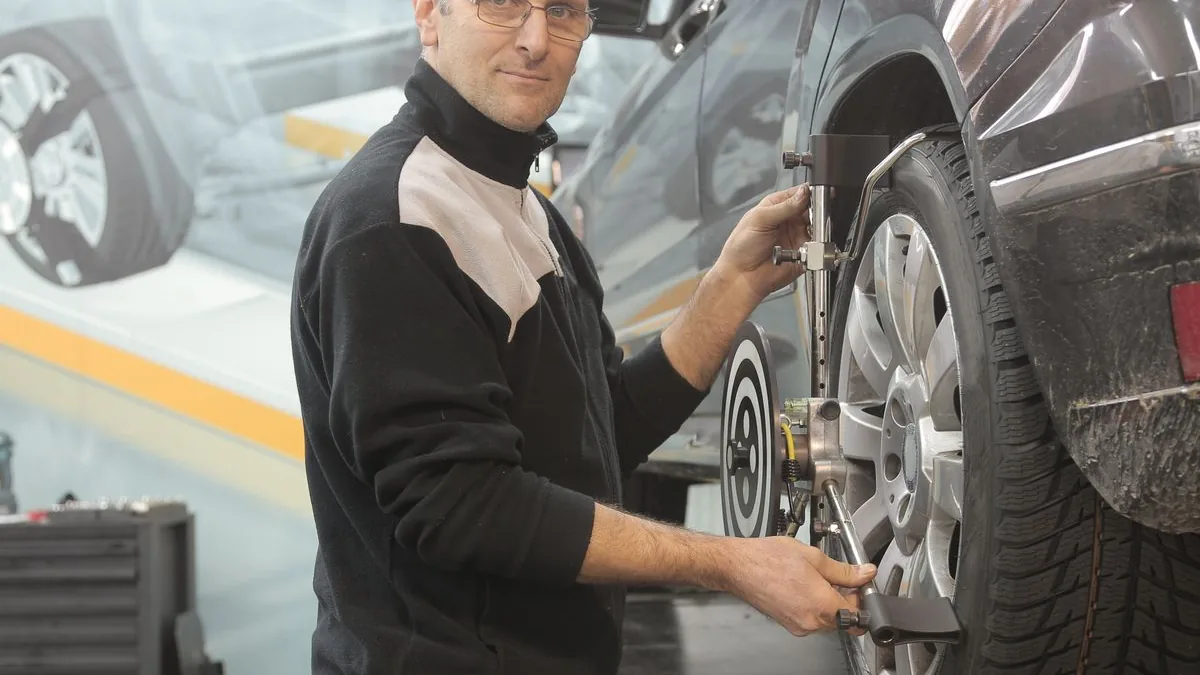
Hunter's camera-based four-wheel alignment is used in professional workshops worldwide. Targets clamp to each wheel, high-resolution cameras read their exact position, and the software compares your live angles against manufacturer specifications. As the technician adjusts a component, the on-screen readings update instantly, so each angle can be dialled into its green tolerance band.
The scale behind the platform is a genuine strength. Hunter reports that its camera-based HawkEye Elite systems can capture full alignment measurements in around 70 seconds using four high-resolution cameras, with a vehicle database supporting more than 285 million vehicles (Hunter Engineering: Hawk Eye Elite). That broad, regularly updated database matters for newer models, where the correct spec has to be on file before we can align to it.
What our technicians value most is the live feedback and speed. There is no guesswork between adjustment and result, which makes it a dependable workhorse for everything from family hatchbacks to performance saloons. If you want the detail on our specific service, our Hunter wheel alignment page walks through it.
What does the Hawk Eye camera add?
The Hawk Eye name refers to the high-definition cameras that do the measuring. Because the measurement is optical rather than mechanical, it reads where each wheel actually sits, and the software then guides the technician through the correction step by step, checking every adjustment against the figures your carmaker set for the vehicle.
You can read more about how we use it on our Hawk Eye wheel alignment page.
How accurate are camera-based alignment systems?
Camera alignment measures to fractions of a degree, which is far finer than the human eye or a string line can manage. Camera-based alignment reads the real position of each wheel rather than estimating it, then holds every adjustment against the manufacturer's exact figure. That precision is the whole point of modern optical equipment.
Accuracy at this level matters because small errors compound. A toe setting that looks fine to the eye can still scrub a tyre steadily across thousands of miles. Camera alignment removes that ambiguity by showing the live number, so the technician adjusts until the reading sits inside the green band, not until it merely looks straight.
It is worth repeating that the equipment sets the ceiling, not the floor. A skilled operator will out-perform a rushed job on the most expensive kit available. The camera does the measuring; the technician does the judging, checking for worn bushes, seized adjusters and prior accident damage that a machine alone will not flag.
Do I need to ask for Hunter or Hawk Eye by name?
No. What matters is asking for a four-wheel alignment rather than a front-only tracking check, because a four-wheel measurement sets the front wheels to the rear axle's thrust line. See our guide to two-wheel vs four-wheel alignment for when that matters.
New tyres are another common trigger. Fitting fresh rubber is the ideal moment to check alignment, because you protect that new tread from the first mile. You can browse options on our tyres page, with new tyres from £35.
How much does wheel alignment matter for tyres and fuel?
A great deal. Misalignment is one of the most common causes of premature, uneven tyre wear, and it quietly costs you money at the pump too. Because a camera alignment sets the wheels back to factory spec, the correction directly protects your tyres and your fuel economy.
The figures are striking. TyreSafe reports that misalignment can prematurely reduce a tyre's lifespan by up to 25%, while correcting it can improve fuel efficiency by as much as 10% (TyreSafe: wheel alignment). A classic warning sign is feathering, where the tread ribs develop a sawtooth pattern, which points to a toe problem you can often feel through the steering.
How often should you check? Advice varies slightly by source. TyreSafe suggests roughly every 10,000 miles or at least once a year (TyreSafe: wheel alignment), while the RAC recommends checking every 6,000 miles or every six months, and sooner after a pothole or kerb strike (RAC: wheel alignment). Either way, a periodic check is cheap insurance against a set of prematurely worn tyres.
What should you expect at our Park Royal centre?
A straightforward, no-surprises process. When you visit Park Royal Tyre & Alignment Centre in NW10, we start by listening to what you have noticed, whether that is a pull, a crooked steering wheel or uneven wear. We then put the car on the rig, take the initial readings and show you exactly where the angles sit against spec.
From there we explain what needs adjusting before any work begins, measured on Hunter Hawk Eye camera equipment. Once the correction is done, you get a clear before-and-after summary and you are welcome to ask questions at any stage. As an RAC and AA approved garage, we welcome walk-ins. To book, use our online booking or contact page, call 020 3886 2355, or send a WhatsApp message to 07476 586 589.
Further reading: How Often Should You Get a Wheel Alignment? and Wheel Alignment After Hitting a Pothole or Kerb.
Frequently asked questions
Is Hunter better than Hawk Eye?
The question does not quite work, because Hawk Eye is made by Hunter: the HawkEye Elite is Hunter Engineering's camera-based aligner. The result depends far more on the technician's skill and the vehicle data for your specific car than on the name on the machine.
Does Hawk Eye alignment set wheels to manufacturer spec?
Yes. Hunter's software stores manufacturer data and checks every adjustment against it, so camber, caster and toe are corrected to the figures your carmaker intended.
How often should I get my wheels aligned?
Guidance ranges from every 6,000 miles or six months, per the RAC, to roughly every 10,000 miles or once a year, per TyreSafe. Check sooner if you have hit a deep pothole or kerb, fitted new tyres, or noticed pulling and uneven wear across the tread.
How long does a wheel alignment take?
A standard four-wheel alignment typically takes under an hour, though it varies with the vehicle and how much adjustment is needed. If components are seized or worn, the job can run longer. We will give you a realistic time once we have inspected your car at our Park Royal centre.
Can you align any make of car?
We align a very wide range of makes and models, from everyday hatchbacks to larger and performance vehicles, using the manufacturer specifications held in the alignment software. Send us your registration and we will confirm before you come in.
Not sure whether your car needs a quick check or a full correction? We are happy to take a look and advise honestly. Drop into Park Royal Tyre & Alignment Centre, Park Royal, London NW10 7TR, call 020 3886 2355, or message us on WhatsApp at 07476 586 589 to book your wheel alignment today.
Hunter 4-Wheel Alignment near you
Prefer to get this sorted locally? Park Royal Tyre & Alignment Centre looks after drivers right across West and North-West London:
Same-Day Tyre Fitting & Walk-Ins Welcome
New tyres fitted from £35 while you wait, plus puncture repairs, wheel balancing and battery replacement at our Park Royal workshop. No appointment needed for tyres, just call in.