Tracking vs Wheel Alignment: Are They the Same Thing?

Tracking and wheel alignment are not quite the same thing, even though almost every garage uses the two words as if they are identical. In plain terms, tracking adjusts the toe angle of the front wheels only, while a full wheel alignment checks camber, caster and toe across all four wheels and ties them to the vehicle centreline. Tracking is the quick, cheap fix for the most common fault. Full alignment is the complete geometry service. Here at our Park Royal workshop, drivers ask us to explain this almost daily, so let us clear up the terminology and help you decide what your car actually needs.
Key takeaways
- "Tracking" usually refers to adjusting front toe only, the most common geometry fault.
- Full wheel alignment measures camber, caster and toe across all four wheels.
- Tracking is quicker and cheaper, but it can miss rear and angle problems.
- Most modern cars benefit from full four-wheel alignment rather than tracking alone.
- The RAC advises a wheel alignment check every one to two years, and after any hard kerb or pothole strike.
What does "tracking" actually mean?
Tracking is the traditional British term for adjusting the toe angle of the front wheels so they point straight ahead. It is the single most common alignment correction, because front toe drifts easily after kerb knocks and potholes. A tracking check is fast, affordable and fixes the fault behind most rapid front-tyre wear.
The word comes from the idea of the wheels "tracking" true along the road. When toe is correct, both front tyres roll parallel rather than scrubbing inward or outward. That scrubbing is what shreds tread and tugs at the steering.
The catch is scope. Traditional tracking looks at front toe and little else, so it can leave camber, caster and both rear wheels completely unchecked.
What does a full wheel alignment cover?
A full wheel alignment measures three angles, camber, caster and toe, on all four wheels against your manufacturer's specification. Rather than just pointing the front wheels straight, it references the rear axle's thrust line so the whole car drives true with a centred steering wheel. It is the complete geometry service, not a single adjustment.
Camber
Camber is the inward or outward tilt of a wheel viewed head-on. Too much tilt wears one tyre edge faster than the other. Kerb strikes and tired suspension bushes are common culprits behind a camber that has crept out of specification.
Caster
Caster is the forward or rearward lean of the steering axis. It governs straight-line stability and how the wheel self-centres after a turn. Caster rarely shifts without a heavy impact, but when it does the car can feel nervous or reluctant to hold a line.
Toe across all wheels
A full alignment sets toe at the front and checks it at the rear too. On many modern cars the rear geometry moves over time, so measuring it is the only reliable way to set the front correctly and keep the steering wheel centred.
What are the key differences between tracking and alignment?
The key difference is scope. Tracking adjusts front toe in isolation, while a full alignment measures camber, caster and toe across every wheel and ties them to the vehicle centreline. Tracking is the quick fix; full alignment is the thorough diagnosis. One treats a symptom, the other checks the whole geometry.
Cost and time follow that logic. Tracking is cheaper and takes minutes, which suits a straightforward front-toe correction. Full alignment costs a little more and adds time, but it catches faults a tracking check simply cannot see. The RAC estimates that UK drivers pay around £90 to have front and rear wheels realigned, and recommends a check every one to two years (RAC: wheel alignment cost guide).
Confusion arises because many garages loosely call any front-toe job "alignment". When you book, it pays to ask exactly which angles and which wheels are included, so you know precisely what you are paying for.
Which one does your car actually need?
Most modern cars benefit from a full alignment because they use independent or semi-independent rear suspension, where the rear angles can drift. Front-wheel-drive hatchbacks, saloons, estates, SUVs and crossovers nearly all fall into this group. For these vehicles, tracking alone risks leaving genuine faults uncorrected.
When tracking may be enough
A simple front-toe correction can suffice on older vehicles with a fixed beam rear axle, where the rear cannot be adjusted and rarely moves. Even then, a quick rear measurement confirms nothing has shifted after a knock, which is worth the reassurance.
Symptoms that point to a problem
Watch for pulling to one side, an off-centre steering wheel on a straight road, feathered or one-sided tyre wear, and vague, wandering handling. Any of these is worth a check, especially after a pothole or kerb strike on West London's patchy roads.
How does misalignment quietly cost you money?
Misalignment costs you money in three ways: it scrubs tread off your tyres prematurely, it raises rolling resistance so the engine burns more fuel, and it can turn a survivable pothole strike into a repair bill. None of these show up all at once, which is exactly why the damage adds up unnoticed.
Britain's roads make this worse than ever. In 2024 the AA attended 643,318 incidents of tyre, wheel, steering and suspension damage linked to potholes, one of the highest tallies since 2017 (TyreSafe: National Pothole Day advice). A pothole that knocks your toe or camber out of specification starts wearing tyres the moment you drive away.
That wear matters for safety, not just cost. The UK legal minimum tread depth is 1.6mm, and driving below it risks a £2,500 fine and three penalty points per tyre (RAC: checking tyre tread). Correct geometry keeps tread wearing evenly so it lasts to a legal, safe depth.
Why is full four-wheel alignment usually the better choice?
Full four-wheel alignment is usually the better choice because it accounts for the entire vehicle, not just the front pair. By referencing the rear thrust line, the technician sets the front wheels correctly first time and avoids the off-centre steering wheel that front-only tracking so often leaves behind.
There is a clear safety and cost benefit too. Correct geometry spreads wear evenly across the tread, so tyres last longer and grip better. That grip is not a small margin: the RAC notes that wet braking distance can be up to 44% worse on a tyre worn to 1.6mm than on one with 3mm of tread (RAC: checking tyre tread). Even wear keeps you further from that cliff edge.
Drivers who book a full check after fitting new tyres protect that investment far better than those who settle for tracking. The small extra outlay upfront often pays for itself in tyre life. You can compare the two approaches on our Hunter wheel alignment page, and browse fitting options from £35 on our tyres page.
What do we do at Park Royal?
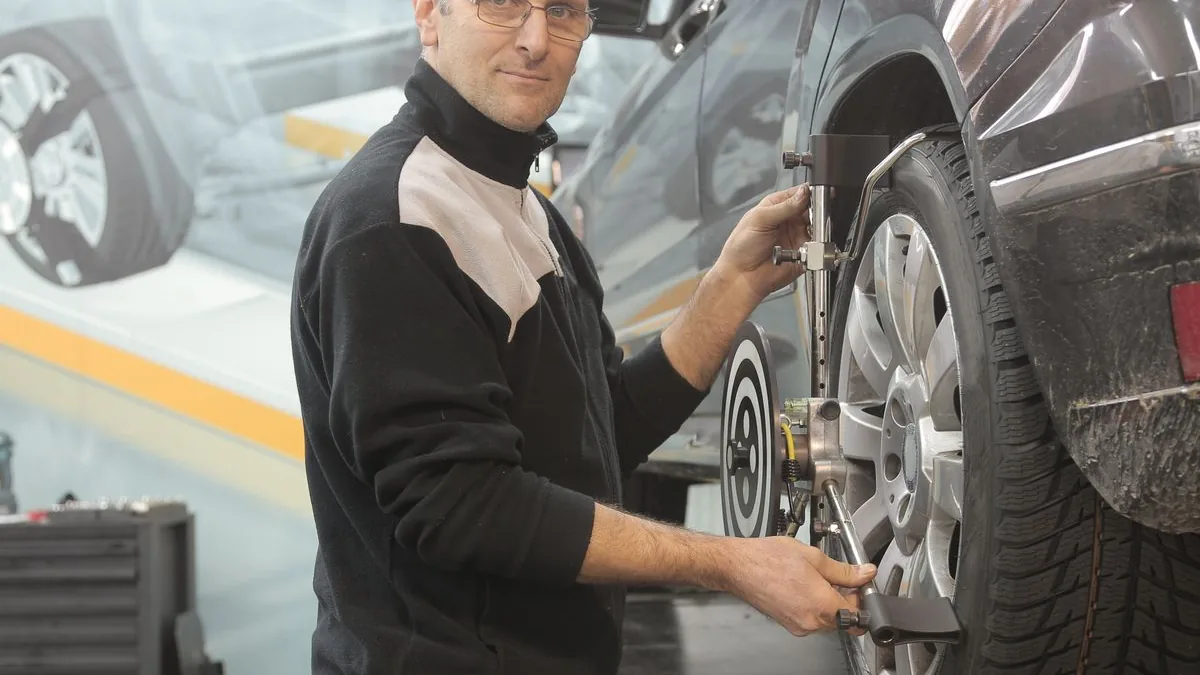
We start every job by measuring all four wheels on our Hunter Hawk Eye camera equipment, then we explain the readings before touching anything. That way you can see whether a simple front-toe adjustment is enough, or whether camber, caster or the rear needs attention. We never upsell work your car does not need.
The cameras photograph targets on each wheel and calculate every angle against the manufacturer's figures, giving a clear before-and-after printout of exactly what was out and where it finished. As an RAC and AA approved garage in Park Royal, NW10, we are handy for drivers across West London, Acton, Willesden and beyond. Learn more on our Hawk-Eye wheel alignment page.
Further reading: How Wheel Alignment Saves You Money on Tyres and Fuel and How Often Should You Get a Wheel Alignment?.
Frequently asked questions
Is tracking the same as wheel alignment?
Not quite. Tracking usually means adjusting front toe only, whereas a full wheel alignment measures camber, caster and toe across all four wheels. People use the words interchangeably, but the services differ in scope, time and cost, so always check exactly what is included before you book.
How often should I have either done?
The RAC suggests a check every one to two years, plus any time you fit new tyres, hit a deep pothole or mount a kerb hard. If you notice pulling, uneven wear or an off-centre steering wheel, book a check sooner rather than waiting for the mileage to tick over.
Will tracking fix a steering wheel that sits crooked?
Sometimes, but not always. If the rear wheels are slightly skewed, front-only tracking can leave the steering wheel off-centre. A full alignment references the rear thrust line first, so the wheel finally sits straight once the front is set to match the rest of the car.
Can alignment reverse uneven tyre wear?
No. Correct geometry stops further uneven wear, but it cannot undo damage already in the tread. A badly worn or feathered tyre may still need replacing. Aligning the car afterwards then protects the new tyre so it wears evenly from the start.
Do I need alignment after hitting a pothole?
It is well worth a check. Potholes are a leading cause of geometry and suspension damage in the UK, and a knock hard enough to jar the steering can shift your toe or camber instantly. A quick measurement confirms whether anything has moved before it costs you tyres.
Still unsure whether you need tracking or a full alignment? Bring your car to Park Royal Tyre & Alignment Centre in Park Royal, London NW10 7TR. We measure first, explain what we find, then recommend only what is necessary. Call us on 020 3886 2355, message us on WhatsApp at 07476 586 589, or book your alignment check online today.
Wheel Alignment near you
Prefer to get this sorted locally? Park Royal Tyre & Alignment Centre looks after drivers right across West and North-West London:
Same-Day Tyre Fitting & Walk-Ins Welcome
New tyres fitted from £35 while you wait, plus puncture repairs, wheel balancing and battery replacement at our Park Royal workshop. No appointment needed for tyres, just call in.